News Information
2026-06-03
No Examination, No Construction! From Planning to AI Algorithms, Urban Renewal Enters the Era of “Diagnosis before Renewal”
On 15 May 2026, the State Council approved the 15th Five-Year Plan for Urban Renewal. The Ministry of Housing and Urban-Rural Development has made it clear: examination before renewal – no examination, no construction. Cities must undergo comprehensive “health checks”. Meanwhile, the plan calls for revitalising underutilised factory sites and renovating about 1,500 old industrial blocks.
01
“Examine Before Renewal” – Who Will Perform a CT Scan for the City?
Traditional methods rely on manual surveys and empirical judgement – long cycles, narrow coverage and difficulty in quantification. Now that “no examination, no construction” has become a mandatory rule, urban renewal urgently needs a more efficient and accurate decision-making tool.
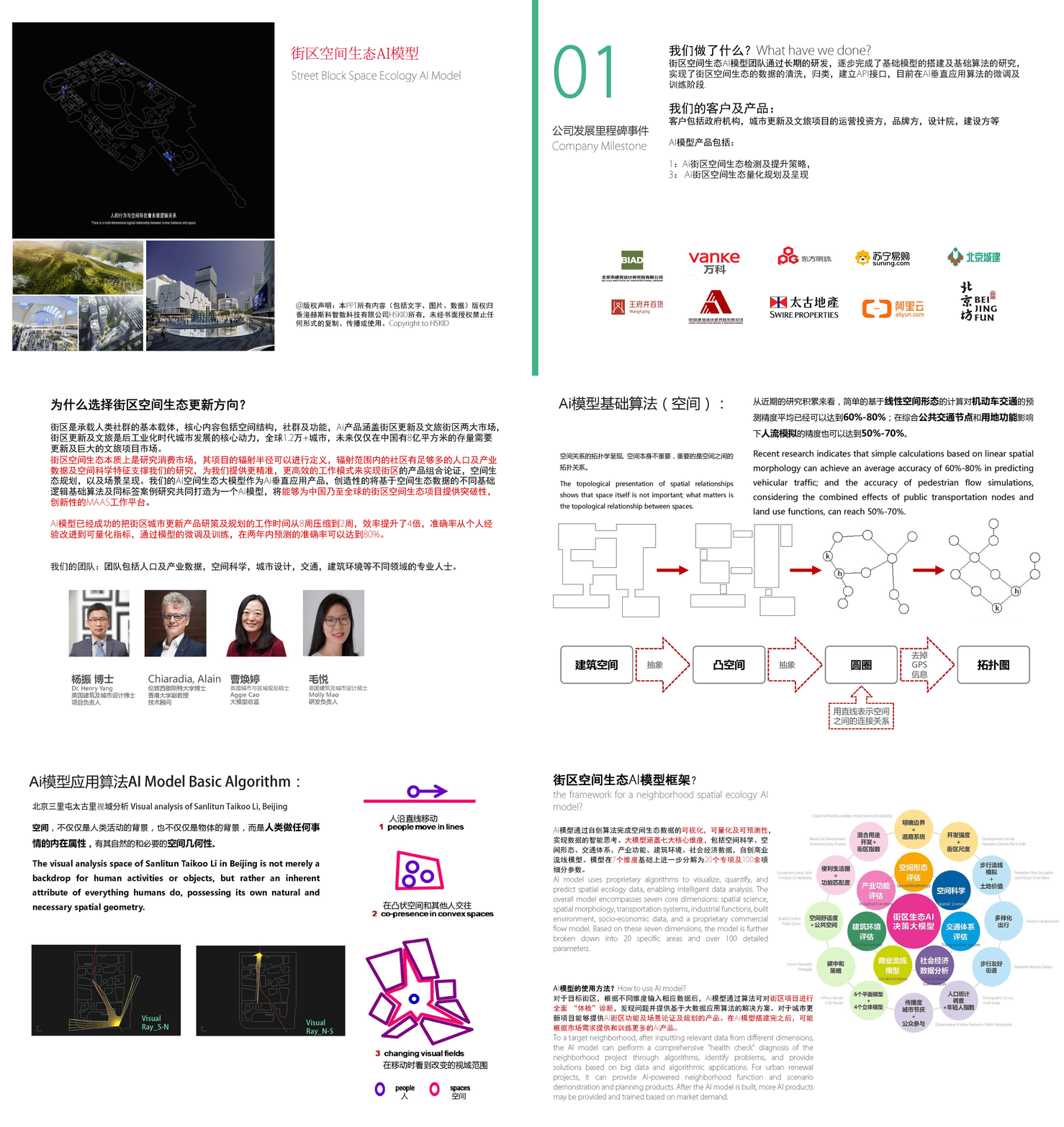
HSKC’s independently developed AI Spatial Ecology Model was created precisely for this purpose. It evolves product research and strategic planning from individual experience to AI algorithms, improving efficiency by four times – reducing the work period from eight weeks to about two weeks. The accuracy of the research data infrastructure has also achieved a breakthrough, reaching 80% , marking a leap from experience-driven to data- and AI-algorithm-driven.
The model integrates six major dimensions – spatial science, morphological analysis, traffic simulation, functional layout, built environment and socio-economic factors – subdivided into 20 specialities and over 100 parameters, forming an intelligent analysis platform that covers the entire lifecycle of urban renewal projects.
Today, the model has been widely applied in cooperation with government departments, national research programmes, R&D institutions and developers. In projects such as urban renewal in Tongzhou, Beijing, and various projects in Zhengzhou, it has played a key decision-support role in pedestrian flow simulation, commercial circulation optimisation and spatial value assessment.
Enable diagnosis upfront, ground planning in evidence. This is the “intelligent decision-making system” for urban renewal.
02
Regeneration of Old Industrial Sites: A Decade of Deep Cultivation – Empowering Projects Through Strategic Planning
The 15th Five-Year Plan explicitly calls for the renovation of about 1,500 old blocks and industrial sites. How can industrial relics retain their memory while being revitalised?
HSKC has long focused on the early-stage planning and concept design of old industrial sites and industrial heritage. Our cumulative practice covers more than ten cities across the country, ranging from light industrial workshops to heavy industrial complexes. Below are some representative projects:
Zhengzhou Memory · Oil Chemical Factory
Beijing Coking Plant Regeneration Project
Zhengzhou Ersha Cultural and Creative Park
Kaifeng Fifth Grain Depot Construction Project
Shijiazhuang State-owned Cotton Mill Urban Renewal Project
Beijing Xiaoguan Regeneration Project
Shanghai Tea Factory Regeneration Project
Not every project has been completed, but each one has enriched our understanding of industrial heritage and how to approach its transformation. It is this continuous accumulation of dozens of projects that gives us systematic experience in the field of old industrial site renewal – from diagnostic “health checks” to strategic planning.
03
Technological Foresight: Redefining the Boundaries of Design with AI
While many projects chase “internet-famous styles” only to fade quickly, HSKC has never delivered a momentary scene. Instead, we provide the soil and algorithm that continuously grow new scenes – a fully integrated chain from AI-driven diagnosis to strategic planning and architectural design.
Use AI to run a “health check” first, then let history truly live into the future.
If you are focusing on an urban renewal project or have old factories or blocks waiting to be revitalised, please feel free to contact us.